
Proper preventive maintenance is essential to ensure reliable performance, reduce unexpected failures, and extend the operational life of window air conditioning units.
A structured preventive maintenance program not only improves cooling efficiency but also minimizes energy consumption, repair costs, and equipment downtime.
This standard preventive maintenance procedure has been developed as a practical guide for HVAC technicians, maintenance contractors, and facility management teams responsible for servicing window-type air conditioning units. It can also be used as a training reference for newly appointed maintenance personnel involved in HVAC maintenance operations.
Purpose
The objective of this procedure is to establish a standardized method for carrying out preventive maintenance of window air conditioners to achieve the following goals:
- Maintain optimum cooling performance.
- Prevent unexpected equipment failures.
- Increase equipment service life.
- Improve indoor comfort and air quality.
- Reduce electricity consumption.
- Ensure safe maintenance practices.
- Standardize maintenance activities across all facilities.
Scope of Work
This procedure applies to all window-type air conditioning units covered under preventive maintenance contracts or facility maintenance programs.
The maintenance activities include:
- Monthly inspection and servicing
- Annual preventive maintenance
- Cleaning of condenser and evaporator coils
- Air filter cleaning or replacement
- Electrical inspection
- Compressor inspection
- Fan motor inspection
- Functional performance testing
- Completion of maintenance records and checklists
Responsibilities
HVAC Technician
The HVAC maintenance technician shall:
- Perform all maintenance activities in accordance with this procedure.
- Follow all project safety requirements.
- Use calibrated testing instruments.
- Report any abnormal operating conditions.
- Replace damaged components where required.
- Complete preventive maintenance records after servicing.
Site Supervisor
The Site Supervisor shall:
- Verify that maintenance activities are completed according to the approved procedure.
- Ensure technicians have the required tools and personal protective equipment (PPE).
- Monitor work quality and safety compliance.
Maintenance Engineer
The Maintenance Engineer shall:
- Review maintenance reports.
- Verify corrective actions for identified defects.
- Schedule periodic preventive maintenance.
- Ensure availability of spare parts and consumables.
Required Tools and Equipment
The following tools may be required depending on the maintenance activity:
- Screwdriver set
- Adjustable wrench
- Clamp ammeter
- Digital multimeter
- Pressure washer or jet pump
- Soft cleaning brush
- Coil cleaning sprayer
- Approved coil cleaning chemical
- Dry cleaning cloth
- Plastic sheet for motor protection
- Flashlight
- Ladder (if required)
Required Personal Protective Equipment (PPE)
Maintenance personnel shall wear appropriate PPE including:
- Safety shoes
- Protective gloves
- Safety goggles
- Dust mask (during cleaning)
- Coveralls
- Hearing protection (where necessary)
Monthly Preventive Maintenance Procedure
1. General Inspection
Before starting maintenance:
- Verify the unit is operating normally.
- Check cooling performance.
- Listen for unusual noises.
- Inspect the unit for visible damage.
- Ensure airflow is not obstructed.
- Check the power cord and electrical plug for damage.
2. Condenser Coil Cleaning
Dirty condenser coils significantly reduce cooling efficiency and increase compressor workload.

Maintenance Procedure
- Switch OFF the air conditioner.
- Disconnect the power supply completely.
- Carefully remove the unit from its cabinet.
- Obtain assistance when lifting heavy equipment.
- Move the unit to a suitable cleaning area.
- Protect the fan motor by covering it with a waterproof plastic sheet.
- Remove the condenser fan shroud.
- Carefully expose the condenser coil without stressing refrigerant piping.
- Apply an approved HVAC coil cleaning chemical evenly across the condenser surface.
- Allow the cleaning solution to react according to the manufacturer’s recommendations.
- Wash the coil using low to medium water pressure.
- Flush away all dirt and chemical residue.
- Tilt the unit slightly to allow complete drainage.
- Dry all electrical components thoroughly.
- Remove protective plastic from the motor.
- Reinstall the condenser assembly.
- Tighten all fixing screws securely.
- Return the unit to its original cabinet.
- Restore power after ensuring the unit is completely dry.
- Carry out housekeeping and dispose of waste materials properly.
Important: Never bend or apply excessive force to refrigerant tubing while handling the condenser assembly.
3. Air Filter Cleaning
A clean air filter improves airflow, indoor air quality, and cooling performance while reducing compressor loading.
Cleaning Procedure
- Switch OFF the unit.
- Disconnect electrical power.
- Open or remove the front panel.
- Carefully remove the air filter.
- Inspect the filter for damage.
- Wash using clean water or a low-pressure jet.
- Remove accumulated dust and debris completely.
- Allow the filter to dry naturally.
- Reinstall the filter.
- Close the front panel securely.
- Restart the unit.
- Verify proper airflow.
Annual Preventive Maintenance Procedure
Annual servicing involves a comprehensive inspection of all mechanical and electrical components.
1. Compressor Inspection
Carry out the following inspections:
- Inspect compressor body condition.
- Check for oil leakage.
- Listen for abnormal operating sounds.
- Inspect excessive vibration.
- Verify anti-vibration mountings.
- Replace damaged rubber mounts if necessary.
- Measure compressor running current using a clamp ammeter.
- Compare readings with manufacturer specifications.
2. Condenser and Evaporator Coil Servicing
Perform complete cleaning of both coils.
Procedure
- Remove the unit safely from its cabinet.
- Cover the fan motor to prevent water ingress.
- Apply approved coil cleaner.
- Clean condenser coil thoroughly.
- Clean evaporator coil carefully.
- Clean the evaporator and condenser coil with approved chemical only.
- Rinse both coils using clean water.
- Remove dirt deposits from drain channels.
- Allow components to dry before reassembly.
3. Fan Assembly Inspection
Inspect all rotating components.
Check the following:
- Condenser fan blade condition
- Evaporator blower wheel
- Fan motor shaft rotation
- Bearing wear
- Bush condition
- Fan balancing
- Mounting bolts
- Noise during operation
- Excessive vibration
Replace defective components where necessary.
4. Electrical Control Inspection
Inspect all electrical control components.
Maintenance includes:
- Thermostat operation
- Temperature settings
- Selector switch operation
- Capacitor condition
- Electrical wiring
- Insulation condition
- Terminal tightness
- Power cord condition
Measure and record:
- Supply voltage
- Operating current
- Supply air temperature
- Return air temperature
5. General Inspection
Carry out a complete condition assessment of the unit.
Inspect:
- Cabinet condition
- Rust or corrosion
- Refrigerant piping
- Drain system
- Fasteners
- Insulation
- Airflow
- Cooling performance
- Unusual noise
- Vibration levels
Replace worn or damaged components whenever required.
Functional Testing
After completing maintenance:
- Restore electrical power.
- Start the air conditioner.
- Verify compressor operation.
- Confirm condenser fan operation.
- Confirm evaporator blower operation.
- Check thermostat functionality.
- Measure discharge air temperature.
- Check for abnormal vibration or noise.
- Ensure condensate drains properly.
- Confirm stable cooling performance.
Housekeeping
Upon completion of maintenance:
- Clean the work area.
- Remove waste materials.
- Dispose of used cleaning chemicals according to environmental requirements.
- Return all tools to storage.
- Complete maintenance documentation.
AC Preventive Maintenance Checklist
The following items should be included in the routine ac maintenance checklist:
| Inspection Item | Monthly | Annual |
|---|---|---|
| Air filter cleaning | ✔ | ✔ |
| Condenser coil cleaning | ✔ | ✔ |
| Evaporator coil cleaning | — | ✔ |
| Compressor inspection | — | ✔ |
| Compressor current measurement | — | ✔ |
| Fan motor inspection | — | ✔ |
| Fan blade condition | — | ✔ |
| Thermostat operation | — | ✔ |
| Selector switch inspection | — | ✔ |
| Electrical terminal tightening | — | ✔ |
| Supply air temperature measurement | ✔ | ✔ |
| General operational inspection | ✔ | ✔ |
Conclusion
Implementing a structured preventive maintenance program for window air conditioning units significantly improves equipment reliability, energy efficiency, and occupant comfort.
Routine cleaning, systematic inspections, and timely replacement of worn components help prevent costly breakdowns while maximizing the service life of HVAC equipment.
By following this method statement, maintenance personnel can ensure consistent performance, safe working practices, and compliance with facility maintenance standards.
Alternate Procedure for Window ac Unit Repair
The purpose of this air conditioner repair and maintenance procedure is to establish a standard PM procedure for the preventive maintenance of Window Type Air-conditioning Units. This will also serve as guideline for newly hired employee in the maintenance or facility management company which will be dealing and doing the maintenance of window type AC air-conditioning units.
The scope of this standard procedure covers all Window air conditioning units which are under the A/C maintenance contract agreement including the window ac maintenance checklist.
It is the responsibility of the A/C Technician to conduct the correct preventive maintenance of Window AC Air conditioning units to prevent system from breakdown, thus providing the specified room temperature and cooling comfort.
AC maintenance technician shall be competent enough to conduct the ac repair and maintenance activity to avoid any damage and to provide the proper result. The project or site supervisor and the in charge engineer shall assure the successful implementation of this ac preventive maintenance procedure.
Monthly Preventive Maintenance of Window AC Unit
Condenser Coil Cleaning
Check the condition of the Condenser Coil. If it is still clean, extend the frequency of cleaning to next month. If not, perform the following procedure:
Prior to the work, wear safety shoes, gloves and goggles.
Prepare screw driver, jet pump, chemical cleaning agent (if applicable) multi-meter and adjustable wrench.
Switch OFF the window ac unit.
Remove the plug of the ac unit.
Remove the window type a/c from its cabinet/cover and place it outside in open area.
Caution: Always ask for assistance when lifting heavy objects.
Wrap the fan motor with plastic to avoid water from getting inside the motor.
Remove the screws that hold the condenser fan shroud.
Carefully swing the condenser out.
Spray approved chemical cleaner into the condenser coil and allow it to absorb the chemical.
Caution: Do not swing the condenser far enough to avoid kinking or breaking the refrigerant lines.
Set-up the pressure washer by tapping it to a water supply and connecting it to the correct power source.
Spray condenser with water.
Tilt air-conditioner sideways so that water will run-out.
Remove plastic from fan motor.
Dry all electrical components with a dry cloth.
Carefully move condenser to its original position.
Re-place the screws that hold the condenser to the shroud.
Return the air-conditioning unit to its cabinet.
Perform housekeeping.
Cleaning of Air Filters
Prior to the work, wear safety shoes, gloves and goggles.
Prepare screw driver.
Switch off the window ac unit.
Remove or lift the cover of the indoor a/c unit.
Remove the air filter.
Clean using jet pump or running water.
Let the filter dry.
Install the air filter.
Put back the indoor a/c cover.
Start the unit.
Window AC Annual Preventive Maintenance
Prior to the work, wear safety shoes, gloves and goggles.
Prepare clamp ammeter, jet pump, chemical cleaning agent and screw driver.
Compressor Checking
Check for any undue noise and vibration.
Check anti-vibration mounting. Replace if found defective.
Check the compressor current using clamp ammeter.
Condenser and Evaporator Fans Maintenance
Pull-out the window type a/c unit to its cabinet and move it outside.
Cover the fan motor with plastic to prevent water from entering the motor winding.
Clean the evaporator and condenser coil with approved chemical.
Check condition of condenser fan blades. Replace if found damage.
Check evaporator fan blower. Replace if found any defects.
Check the fan motor condition. Rotate the shaft freely and hear for any bearing or bushing defects. Repair if found any.
Check for any undue noise and vibration. Rectify if found any.
Control Checking
Check thermostat for proper operation. Check temperature setting.
Check selector switch.
Measure the supply air temperature of the unit.
General Condition Checking
Check and tighten all terminal connection.
Clean or replace the air filter.
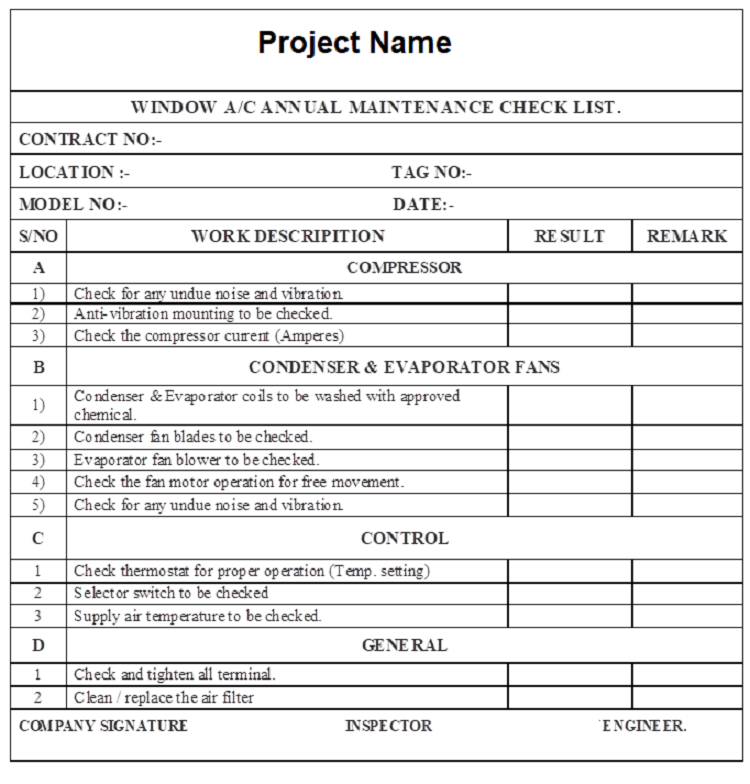
Attachments (Table 1) – Sample Preventive Maintenance Checklist for Window Type A/C
Below is a sample window ac maintenance checklist which is very useful for routine maintenance activity.
Discover more from Method Statement HQ
Subscribe to get the latest posts sent to your email.